Like children returning to school, with shiny shoes and military haircuts, MPs start a new term at Westminster today. The gossip mill is already whirring about rebellions and reshuffles, but there is only one issue that will dominate domestic politics over the next few months: the balance between taxation and public spending.
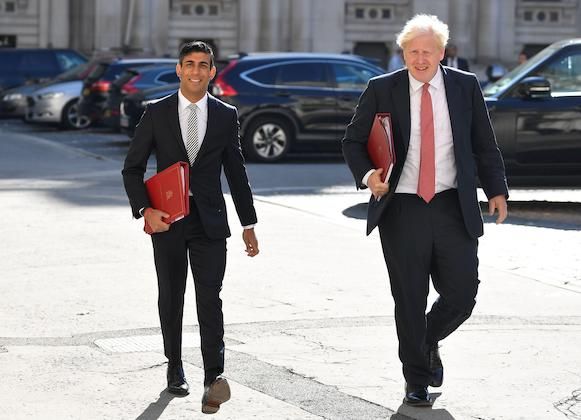
Already the bids are rolling in ahead of the autumn spending review, and the tension between Boris Johnson and Rishi Sunak is ramping up. Tory MPs are preparing for a fight, amid reports that the government is planning to break not one but two Conservative manifesto pledges—by abandoning the so-called “triple lock” on pensions and raising national insurance to pay for an overhaul of social care. One former Cabinet minister predicts a season of “Tory wars” and that “Rishi’s star will wane.”
When Ken Clarke was chancellor he used to complain about doctors, teachers, the military and police waving their “bleeding stumps” at the Treasury whenever public spending settlements were under negotiation. This year the blood is all too real as the pandemic continues to ravage the health service, the education system and the welfare state while refugees flood out of Afghanistan. It is hard to think of a spending round that has been more fraught, or a time when competing pressures were so intense.
The NHS says it needs an extra £10bn a year just to maintain existing services in England. A similar amount is required to fix social care—a pledge the prime minister made on his very first day in Number 10 more than two years ago. To the fury of some ministers and MPs, he seems to have agreed to put up National Insurance to pay for it, a tax on work rather than wealth. Many at Westminster suspect that the threat of a reshuffle is part of a Downing Street attempt to keep the Cabinet in line.
Then there is education. Many of the government’s favourite academy chains are leading the calls for at least £5.8bn more to be allocated to help pupils catch up the learning lost during the pandemic. In a letter sent last week addressed to the Department for Education, Number 10 and the Treasury, they warned that children were months behind academically and facing mental health crises, with the most disadvantaged hardest hit.
The footballer Marcus Rashford is among those lining up against ministers over the planned £20 a week cut to universal credit. Dozens of Tory MPs—particularly those in the politically crucial red wall seats—think it would be a disaster to press ahead with the reduction, which campaigners say could push an estimated 500,000 people into poverty. Analysis by the Joseph Rowntree Foundation found that more than a third of working-age families in 413 parliamentary constituencies would be affected by the cut. Of these, 191 are represented by Conservative MPs.
Meanwhile, the costs of the crisis in Afghanistan are spiralling. Local authorities are demanding more money to cover the cost of housing refugees. The chancellor may have seen off the parliamentary rebellion over cuts to the aid budget before the summer, but he will soon have to open his chequebook to avert an unfolding humanitarian crisis. Money may also need to be paid to neighbouring countries in the region, for processing those fleeing the Taliban after the withdrawal of western troops.
The security services and the police will seize on the increased terrorist threat to press the case for their budgets to be increased. There is also a record backlog in the courts, leading to delays in criminal trials that make it hard for the Tories to claim they are the champions of law and order. The list goes on—and I haven’t even mentioned housing, agriculture or climate change, each of which will make valid demands on the public purse.
There are so many good causes and so little money. Sunak has already warned ministers that they must prepare for a tough spending settlement as he tries to get a grip of a £300bn deficit after Covid. Over the summer he asked Whitehall departments to identify savings as he looked for money to pay for the post-pandemic priorities. But his biggest problem isn’t the ministers in spending departments or rebellious MPs: it’s the prime minister, who is as profligate as the chancellor is tight.
It is not surprising that Johnson and Sunak disagree over priorities. There is always conflict between the Treasury and Number 10. This is partly the necessary difference between their roles. Chancellors always want to save money—their job is to defend the public finances; prime ministers always want to splash the cash—their priority is to keep the public on side and retain power. The tension is, one Whitehall veteran says, the “grit in the oyster” that ensures a good balance in government.
The characters of Johnson and Sunak are also pulling them in different directions. You only have to look at the two politicians to know that the chancellor is a man who prides himself on discipline, rigour and control, whereas Johnson is not afraid to indulge his desires, skimp on the detail and take risks. But another dynamic is also at work which makes the discussions ahead of this spending review particularly difficult.
There has always been an internal incoherence at the heart of the Johnson government and the Brexit project. The Tories’ 80-seat majority at the last election and the 2016 Leave vote both depended on building a coalition between wealthy traditional Tories in the southeast and the party’s new working-class voters in the north and the Midlands. These two groups shared a commitment to leaving the EU and a determination to elect Johnson over Jeremy Corbyn, but on many domestic policies their interests are at odds. The fault line has already started to emerge—over proposed changes to planning laws, for example. And the divergence between the prime minister’s competing power bases is greatest over spending priorities.
The shire Tories like their taxes low and their government pared back. The red wall Conservatives are much more likely to be eligible for universal credit and rely on the public services. The two groups have fundamentally different views about the optimal size of the state and how taxes should be raised (including whether the burden should fall more heavily on income or wealth).
Johnson has survived by telling both groups what they want to hear—having his cake and eating it, as he likes to say. The spending review will force him to choose between competing priorities and rival factions. There will be many rows in the coming weeks, but the most important conflict this autumn is between the constituent parts of the Conservatives’ electoral coalition—and, ultimately, within the prime minister himself.